
By the time of its unceremonious destruction in 1960, Melbourne’s Eastern Market had served the city for over a century, feeding its people through early colonial precarity, the gold-rush era, and into the 20th century.
Established in 1847, the Eastern Market quickly formed the nucleus of daily life in Melbourne, sustaining generations of its citizens as the city expanded from precarious outpost to bustling metropolis.
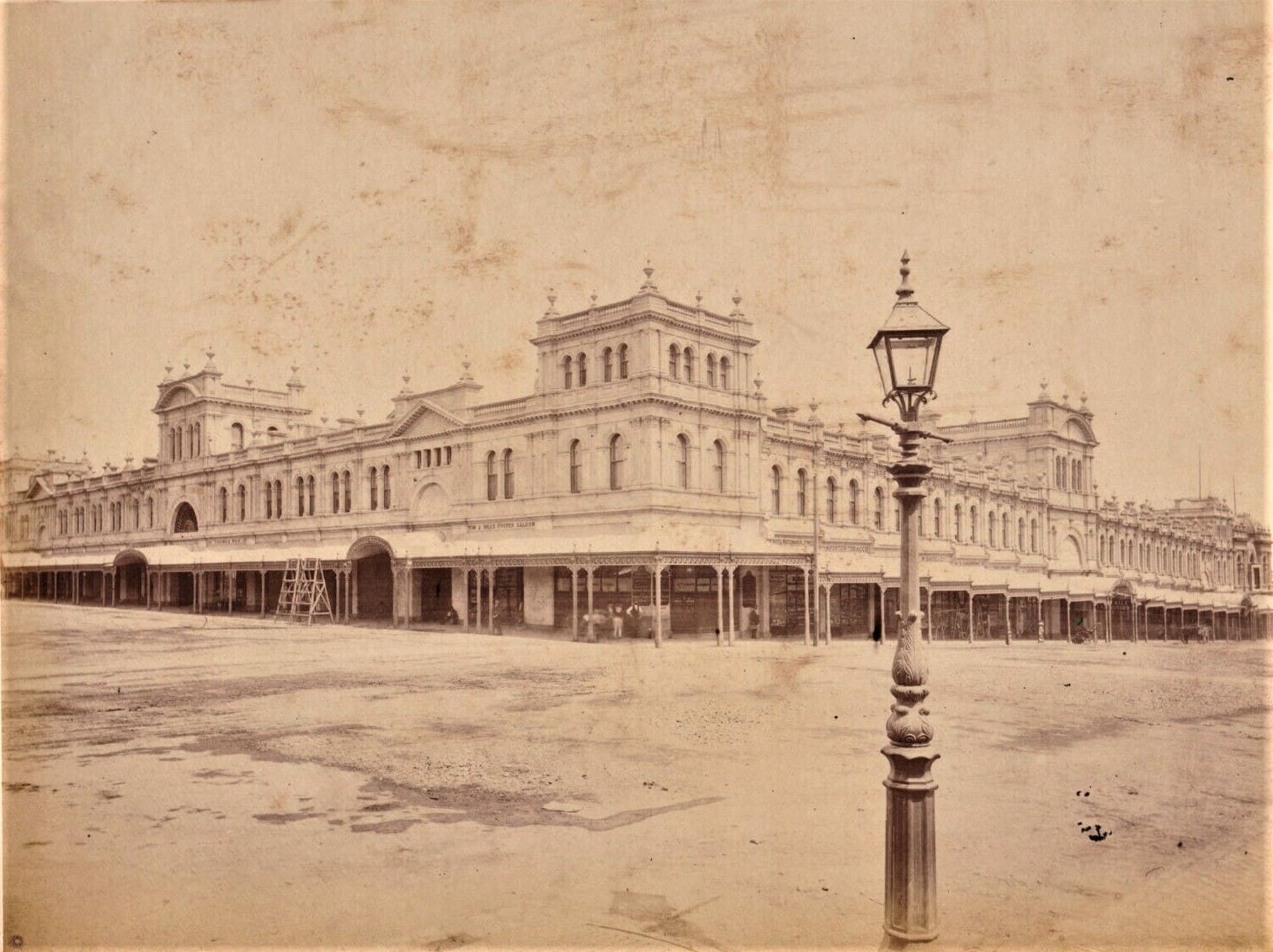
Occupying an entire city block, the Eastern Market was no peripheral institution but a fixed point around which Melbourne organised itself. Traders, shoppers, and hawkers converged daily on the site, serving every layer of the city’s social and economic life. Long before the arrival of zoning laws, the Eastern Market served as infrastructure – noisy, crowded and indispensable.
The 20th century proved unkind to the market, as decades of underinvestment and neglect saw it decline from cultural supremacy to an institution increasingly regarded as outmoded and expendable. It was within this environment, shaped by indifference rather than inevitability, that the conditions for its eventual destruction were laid.
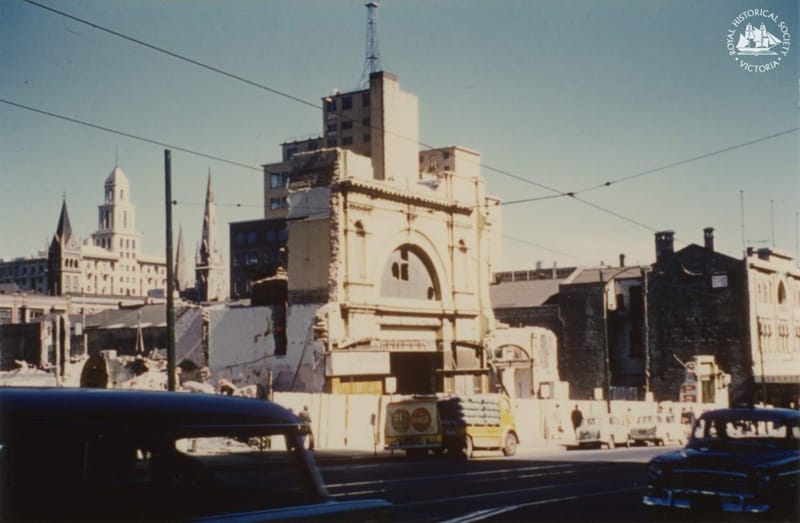
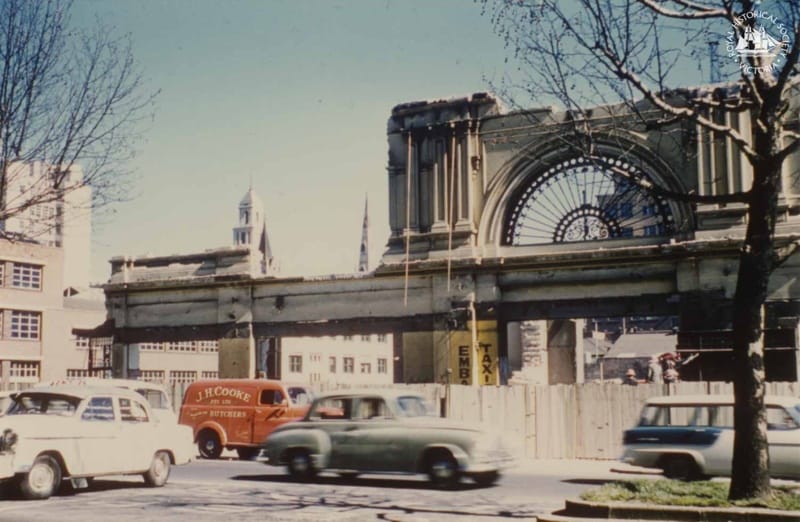
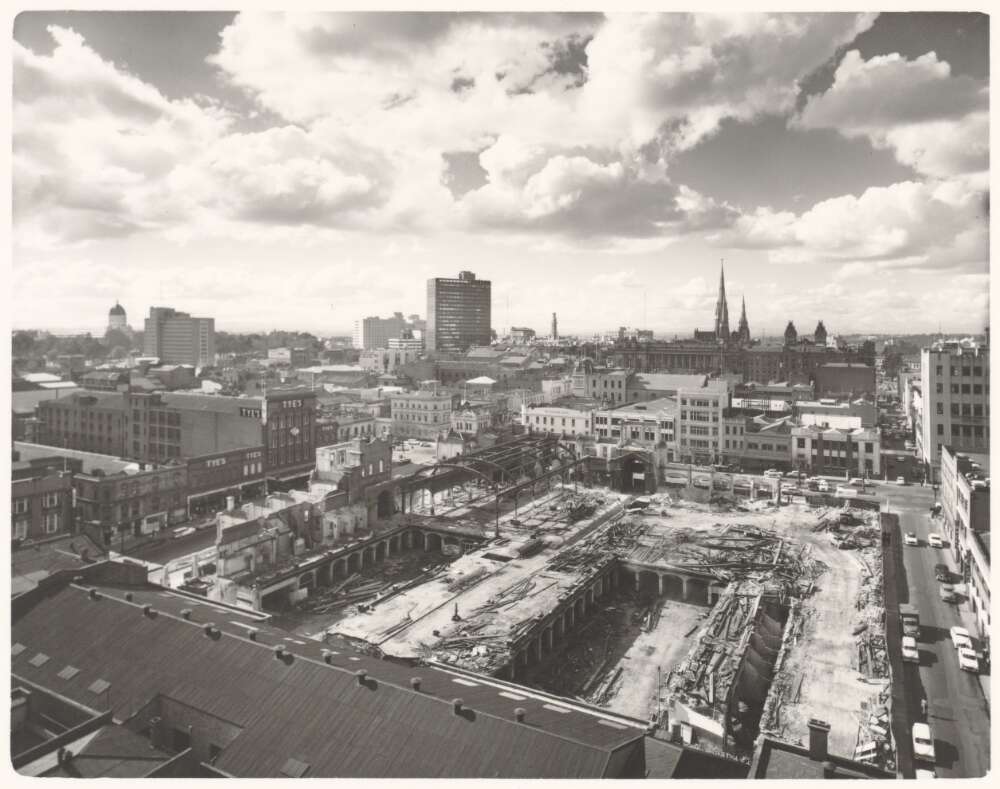
The destruction of the Eastern Market in 1960. Images courtesy of the Royal Historical Society of Victoria (RHSV)
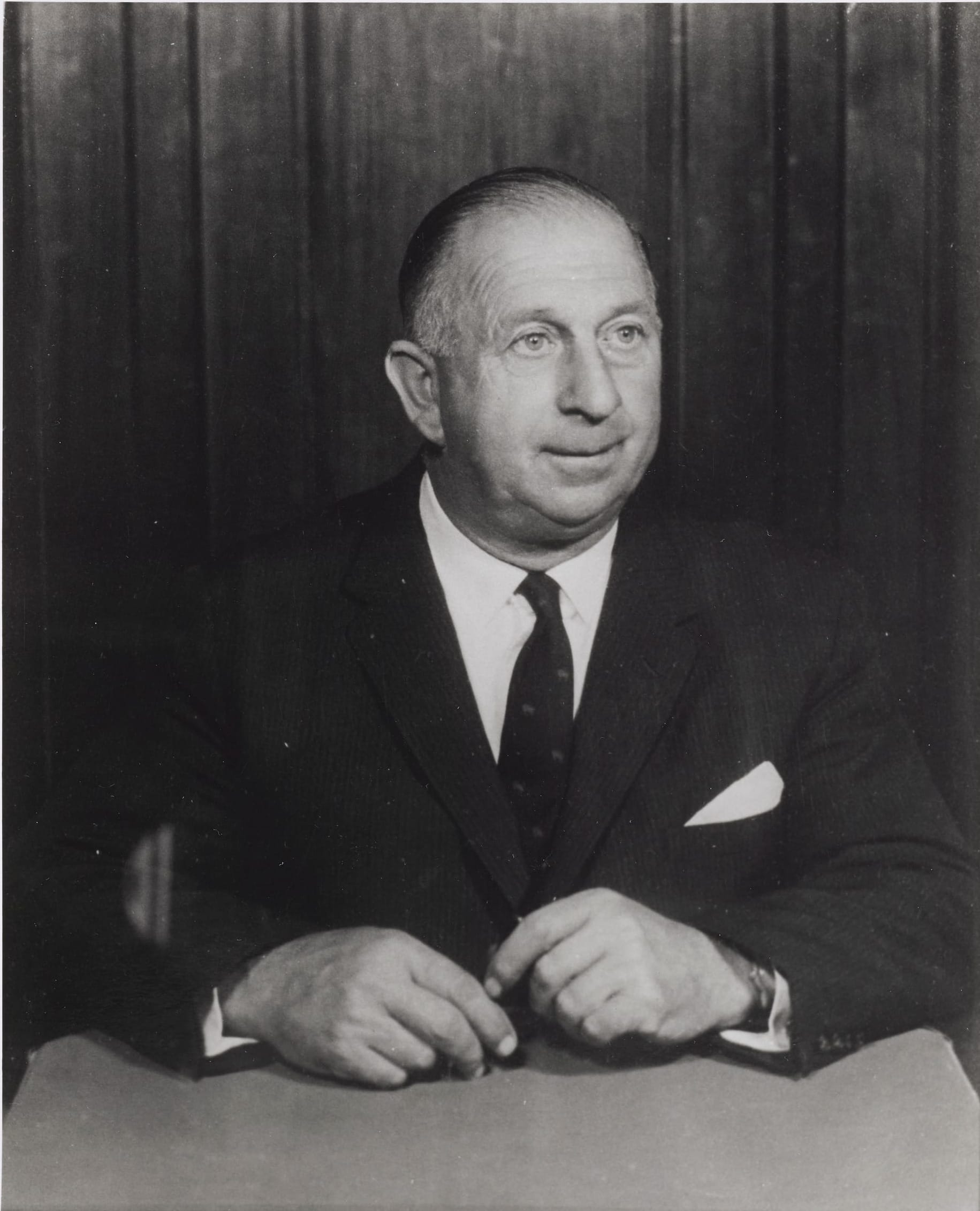
Victoria had elected a new conservative government in 1955, headed by Henry Bolte, that was ideologically comfortable with redevelopment as a civic virtue, and demolition as its necessary companion.
In 1961, that disposition was given legal form with the passage of the Town and Country Planning Act 1961, which sought to reorganise how the city would grow. While the Act established a more centralised and professionalised planning regime, it made no provision for the protection of historic buildings. The omission was decisive. In the absence of any statutory requirement to preserve what already stood, demolition became not a failure of the system, but its most efficient outcome.
What followed was almost thirty years of desecration of Melbourne’s colonial history. It was not, as some defenders later claimed, the inevitable cost of modernisation, but the heady combination of anxiety and complicity. Anxiety, driven by a fear that the city had grown old and irrelevant before its time; complicity, supplied by a political and professional class all too willing to confuse destruction with progress. State and local governments alike fostered a climate in which age — and therefore history — became a liability rather than an asset. Buildings that had survived Melbourne’s booms and busts were now erased with alarming speed and efficiency, all in the name of progress.
The most damning microcosm of this destructive impulse can be found earlier in the twentieth century in the demolition of the Fish Market in 1959. Built in the 1890s in the Victorian Italianate Revival style, the market was not cleared for a new civic institution, nor for improved public infrastructure, but simply to make way for a car park. Few decisions so clearly expose the hierarchy of values that had taken hold: permanence discarded for convenience; architecture for asphalt.
"If we have any pride left in this city, can't we stop crowing about Marvellous Melbourne. We're itching to rip down the Rialto, one of the last really splendid buildings left in Collins Street… Melbourne now resembles the grotesque and pitiful spectacle of a man slapping himself on the back with one hand and slashing his wrists with the other. Why not call ourselves Mutilated Melbourne?" - Barry Humphries, mid-1950s
Critics of the post-war rush to modernise Melbourne often forget how confidently its advocates spoke and acted. To the state government, and to the local authorities that enabled widespread demolition, progress through destruction was treated as inevitable. Henry Bolte was clear minded in his assessment that change had to come regardless of cost, remarking that “Victoria cannot afford to be sentimental about the past if it is to meet the demands of a modern, growing city.”
While the destruction of these historic places is often remembered as acts of cultural vandalism, what replaced them offers an equally damning insight into the priorities of the State Government. The Eastern Market, long a civic space for traders and the public alike, was replaced not by a new form of public infrastructure, but by commercial office development, severing a daily social function that was never restored.
If the destruction of the markets revealed a willingness to engage in the wholesale removal of civic infrastructure, the fate of Collins Street proved something more damning still. Here, at the wealthiest end of the city’s most prestigious boulevard, the targets of modernisation were not derelict structures or obsolete services, but the very buildings that had once embodied Melbourne’s late nineteenth-century confidence, wealth, and architectural ambition. From the late 1950s until the early 1980s, a systematic hollowing-out of the city’s most distinguished commercial thoroughfare was carried out with an indifference so complete it scarcely registered as loss at all.
Over three decades, the “Paris End” of Collins Street was progressively denuded of its colonial character. The APA Building, a grand High Victorian landmark completed in 1888 at Melbourne’s colonial zenith and Australia’s tallest building until 1912, was demolished and replaced by the Southern Cross Hotel—a building that itself survived little more than thirty years before meeting the same fate.
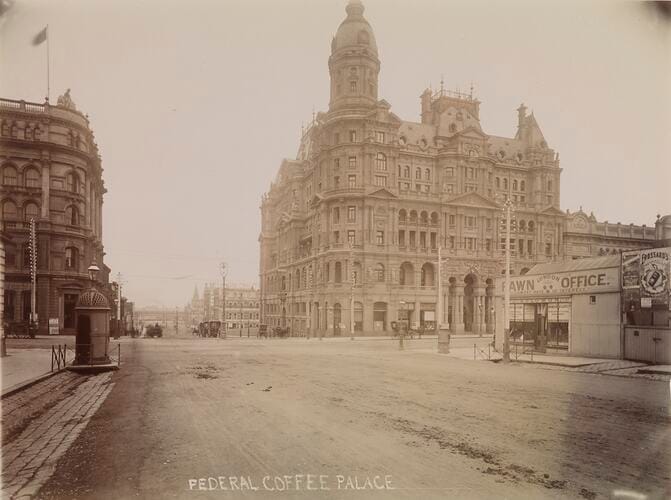
The spree of destruction along Collins Street reached its apogee in 1973 with the demolition of one of Melbourne’s most revered landmarks, the Federal Coffee Palace. The grand Second Empire coffee palace had been allowed to wither across the 20th century, its decline hastened after the collapse of the temperance movement. Its demolition and replacement by an office block reflected both a callous indifference to heritage and the ascendant utilitarian design ethos of the era.
Not even the hallowed world of Melbourne’s higher education was spared the spasms of destruction.
Old Wilson Hall, a striking example of Gothic Revival architecture, was designed to host generations of Melbourne’s finest minds, yet it could not be saved. Severely damaged by fire in 1952, the building may well have been repaired were it not for the prevailing contagion of modernisation. In 1954 the ruins were quietly cleared away to make way for the modernist New Wilson Hall.
By the 1970s, serious opposition to Melbourne’s spree of destruction had begun to emerge, as proposals targeting what remained of the city’s historic buildings exposed just how far redevelopment ideology was prepared to go. Plans to replace the city’s iconic Flinders Street Station with office towers and a car park provoked widespread public backlash.
By the mid-1970s, public tolerance for the wanton destruction of the city’s architectural heritage had begun to wane. The Burra Charter, adopted in 1979, gave formal expression to that shift, reframing demolition not as progress, but as an outcome that now required justification.
The gradual destruction of the city’s heritage character was not driven by a villainous premier or ruthless developers alone, but enabled by public disengagement and a collective anxiety that confused demolition with renewal. The slow loss of Melbourne’s most beautiful public buildings stands as a reminder that destruction and progress are not synonymous, and that the cost of confusing the two is paid long after the rubble has settled.
If the destruction of the Eastern Market revealed how easily civic and community infrastructure could be erased when it lacked defenders, the survival of the city’s Queen Victoria Market demonstrated what could be achieved through sustained community resistance. For decades the market faced repeated threats of destruction, and each time those threats were rebuffed by determined opposition from stallholders and the public alike.
Melbourne did not lose its markets, halls, and grand heritage buildings to an inevitable march of progress. It lost them because their age was mistaken for irrelevance, first by the public, then by the governments that acted on that indifference.
The Eastern Market’s destruction was not inevitable — other grand markets survived — but its value as a communal institution was displaced by the demands of commercial efficiency. The Paris End of Collins Street was not demolished overnight, but was instead allowed to decline through neglect, making its eventual erasure appear both reasonable and necessary.
The lesson we must draw from Melbourne’s loss is not that progress must be checked or that commercialism is the natural enemy of heritage, but that the two can and must be treated with care, proportion, and an understanding that some losses are irreversible. Once we lose our history to indifference, it cannot be reconstructed, replicated, or recovered, only mourned once the damage is done.


