
This story is from the Australian Heritage archives, and was first published in September of 2007.
It was quite a sight for the inhabitants of Melbourne when, on the 4th of February, 1865, the elegant, if somewhat imposing, confederate raider, CSS Shenandoah steamed into Port Phillip Bay. The locals were accustomed to ships laden with immigrants from England, seeking their fortune on the gold fields of Victoria, but a Confederate warship carrying an eight-gun armament and displacing 1,018 tons, caused quite a stir.
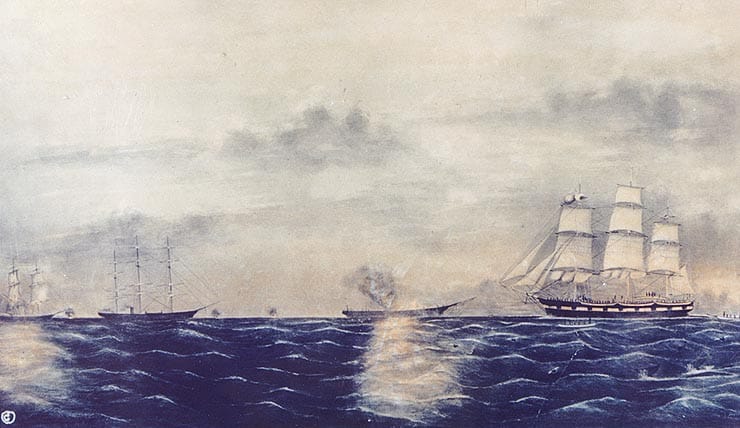
The formidable ship arrived in Williamstown for a speedy repair of its damaged propeller shaft and to take on coal, and its stay was meant to be brief. But news of its arrival spread quickly around the colony, and as it sailed into port, thousands of people arrived at the dock to catch a glimpse of the warship.
The Confederates had purchased the CSS Shenandoah during the American Civil War as the last of eight `raiders' commissioned to capture and destroy Union commerce ships. Originally named the Sea King, the ship was secretly acquired from the docks in Glasgow in late 1864 to replace another raider, the Alabama, which had been sunk in a battle with a Union warship. The Shenandoah had been built as a merchant vessel, propeller-driven by a 250-horsepower steam engine with a top speed of eight knots and double that under sail, but with no armament and no gunports.
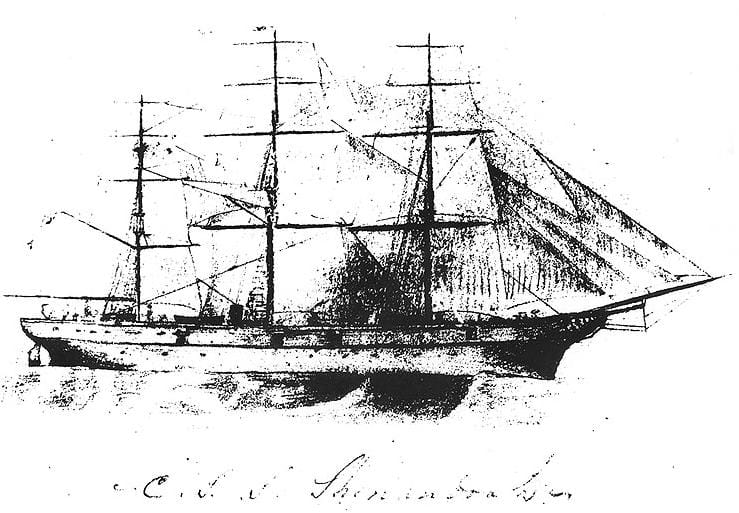
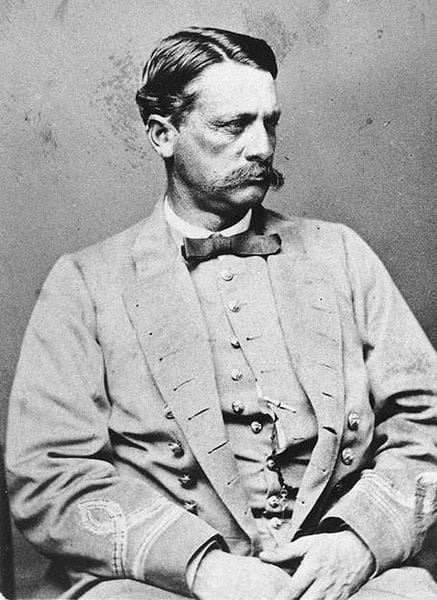
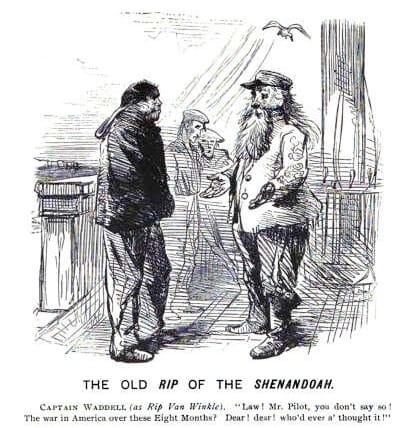
Pencil sketch of CSS Shenandoah, drawn by James Iredell Waddell / Commander James Iredell Waddell (1824-1886), CSN; photographed in Confederate Navy uniform / Editorial cartoon satirizing James Waddell still engaging in combat after the American Civil War was considered over (Images via Wikimedia Commons)
Her new captain, James Waddell was an experienced sailor and a devout Confederate, with orders to take the Shenandoah raiding in the Pacific and Arctic oceans, targeting the American whaling fleet. He joined his ship near Madeira off the coast of Morocco, where a rendezvous had been arranged with another ship from London bringing guns, coal and provisions. On November 20, 1864, after a tricky fit-out performed at sea to convert her to a warship, the Shenandoah set out on her new career with just 42 men on board including officers, less than half the crew a ship of this size would normally have.
Her first theatre of war was the Atlantic ocean, where she captured eleven merchant ships, burning most of them and off-loading prisoners onto a passing Danish brig and an island off the coast of Africa. Some of the crew from the prize vessels joined the crew of the Shenandoah.
Aware that Union warships were in the area, Captain Waddell rounded the Cape of Good Hope in a fierce storm, only to find that the propeller shaft was damaged. Unable to make repairs at sea, he decided to make the 6000 mile journey under sail to dock the Shenandoah where no Union ship would expect to find her - at Melbourne's Williamstown dock.
As a British colony, Australia was a neutral in the Civil War under rules laid down by Queen Victoria. However, the Victorian government decided that as a ship of war commissioned by a foreign government, the Shenandoah would be allowed to remain at Williamstown long enough to complete repairs to bring her back to sea-going condition.
Waddell was confident that the Shenandoah would be safe from Union attack there, but what he did not anticipate was the warmth of the welcome that he and his crew received. One of the ship's officers, Dr F J McNulty, described their reception:
"We were now nearing the coast of Australia, and on the 25th day January, 1865, entered the port of Melbourne. Never was conquering flag at peak hailed with such honors as were given us upon that bright, tropical morning. Steamer, tug-boat, yacht--all Melbourne, in fact, with its 180,000 souls, seemed to have outdone itself in welcome to the Confederates. Flags dipped, cannon boomed, and men in long thousands cheered as we moved slowly up the channel and dropped anchor. The telegraph had told of our coming from down the coast, where we had been sighted with Confederate flag flying, and the English papers had said that the great Semmes (captain of the Alabama) was on board. Evidently the heart of colonial Britain was in our cause."
The hospitality enjoyed by the ship's company throughout their stay was no less generous, and included an invitation to inspect the gold mines at Ballarat and to attend a subscription ball held in their honour. However, opinion was not totally undivided, with some local newspapers branding the crew as pirates and the American consul demanding the arrest of Waddell and the impounding of the Shenandoah.
In the following three weeks, while the Shenandoah was hauled up and repaired, the local infatuation with the vessel and her crew exploded, so much so that forty-two men from Williamstown and Melbourne secretly volunteered for service and boarded the Shenandoah as stowaways, despite the close surveillance of the police.
Waddell, who was desperately short of manpower after 14 of his crew deserted while in Melbourne, welcomed the newcomers and, to the fury of the American consul who rushed a letter of complaint to Governor Darling about illegal recruiting, made a quick getaway under full steam on February 18, 1865, while officials were still considering what was to be done.
With a full crew for the first time, the Shenandoah headed first for the southern Pacific and then north to the Sea of Okhotsk, where she took one ship, and on to the Behring Sea. Completely unaware that the American Civil War had come to a close with the surrender of General Robert E Lee on April 9 1865, Waddell made a solitary assault, capturing 25 and destroying 21 vessels of the unguarded United States north Pacific whaling fleet.
The Shenandoah then headed south towards San Francisco, and it was not until August 3, 1865, when a British trading vessel delivered the news of the defeat of the Confederacy, that the Shenandoah finally ended its attacks. Waddell, fearing that if he returned to the United States he would be executed as a pirate, sailed 17,000 miles to Britain where he surrendered the Shenandoah to the British navy at the port of Liverpool.
His arrival did not improve the already uneasy relations between the United States and Britain, as the Liverpool Mercury reported:
"Since the defeat of the South, the flag of the Confederation has seldom, if ever, been seen on the Mersey. As might be expected, therefore, the appearance of a steamer in the river flaunting the Palmetto excited considerable attention, and, as we have stated, some apprehension was felt as to the intention and destination of the redoubtable stranger.
"The Shenandoah is a smart, handsome looking craft, with black painted hull and unmistakably rakish rig, and appears to be altogether a quick and serviceable vessel. She has a crew of 130 men, and a ballast of coals.
"At the present juncture, when so many knotty points of international law are at issue between this Government and the United States, and when the maintenance of amicable relations between the two countries is so much to be desired, and is so essential to the welfare of both, the absence of the Shenandoah from this port was more to be desired than her presence. There can be little doubt that after the necessary formalities are gone through, the vessel will be handed over to the United States authorities. However, some question may arise as to the detention of her crew, a subject that may lead to misunderstandings that had better been avoided."
In the event, the officers and crew were paroled. Waddell did not return to the United States for ten years, when he became the captain of the commercial steamer, City of San Francisco. He was briefly recalled to active service by the governor of Maryland to take charge of the war against the Chesapeake Bay oyster pirates which, after a few days of conflict, he wiped out completely. Waddell passed away quietly in Maryland on March 15th, 1886.
In her brief career as a warship, the Shenandoah destroyed a total of 38 American ships and took more than 1000 prisoners. After her surrender to the British Government, she was converted back to a merchant vessel and handed over to the United States government. Before leaving Liverpool, she was sold to the Sultan of Zanzibar for use as a personal yacht, and later became a trading vessel, remaining in service until she hit a reef and was completely destroyed.
The exploits of the Shenandoah had some lasting repercussions. Attempts by the US government to gain compensation for damage inflicted on Northern merchant ships by Confederate raiders that had been built, fitted out or aided by British interests led to the Treaty of Washington in 1871. Under the Treaty, an international court of arbitration made up of a panel of independent nations was created for the settlement of disputes between nations - an arrangement that still exists today.
In 1872, a tribunal held in Geneva awarded the United States damages of US$15.5 million against Great Britain for its breaches of neutrality during the Civil War. In particular, these breaches related to the building and fitting out two raiders, the Florida and Alabama, to Governor Darling's action in allowing the repair of the Shenandoah in Williamstown and to the presence of Australian seamen on board the Shenandoah.


